先用一句話看懂The study in one sentence
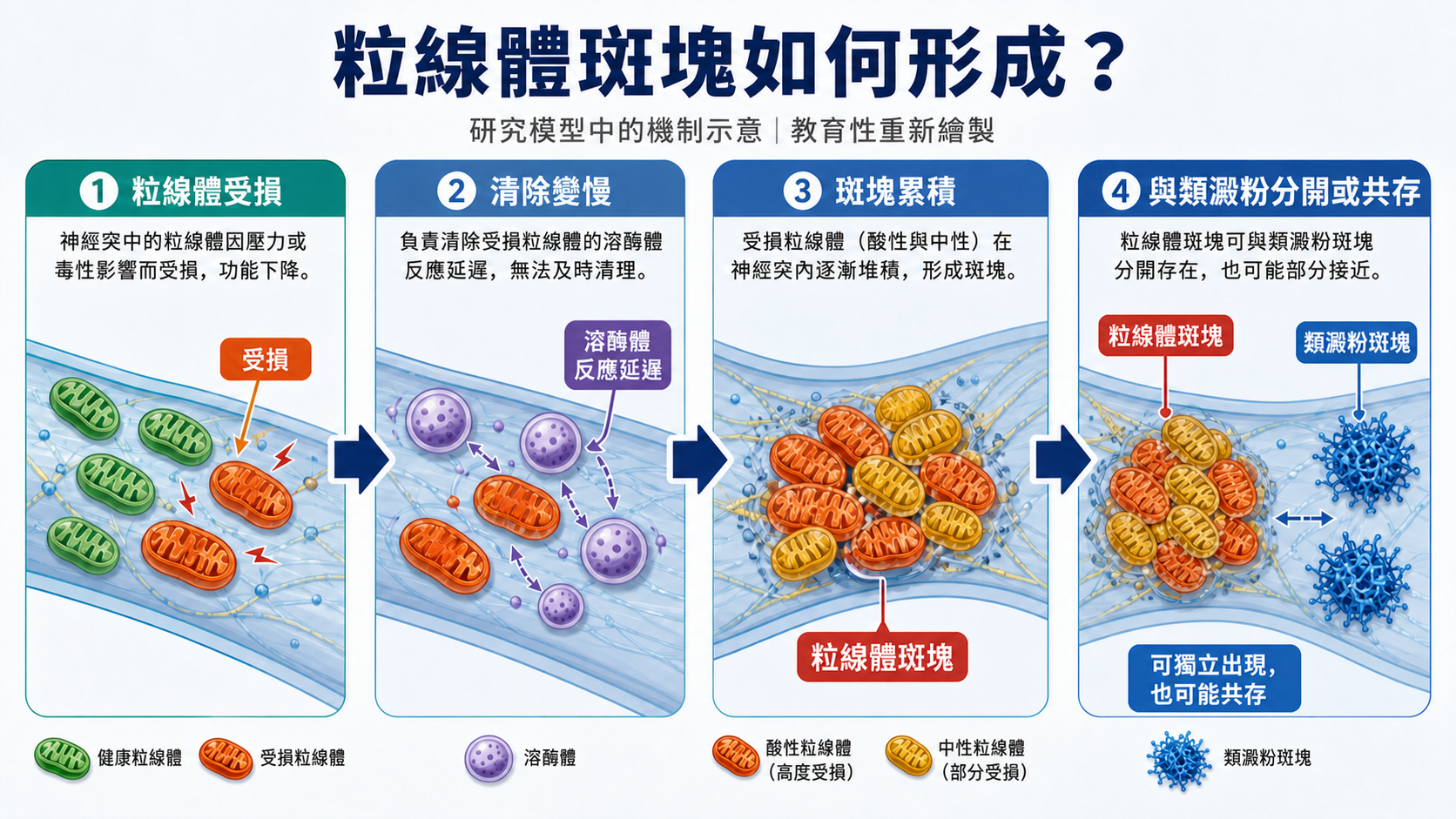
研究者發現:受損粒線體先在神經突裡堆積,負責分解它們的溶酶體來得太慢、處理也不完整,最後形成一種新的大型聚集結構——粒線體斑塊(MPs)。Damaged mitochondria accumulate first; lysosomes arrive late and fail to finish degradation, producing large aggregates termed mitochondrial plaques (MPs).
論文真正追問的是:「粒線體壞掉之後,細胞有沒有及時把它們收走?」The central question is not simply whether mitochondria are damaged, but whether the cell removes them in time.
研究者實際做了什麼?What did the researchers do?
- 在小鼠模型追蹤粒線體。使用 APP/PSEN1/mt-Keima 與 5xFAD 模型,觀察神經突中的粒線體。
- 比較累積與清除的時間。檢查粒線體何時聚集、溶酶體何時靠近,以及內容物是否被完整分解。
- 在人類腦組織確認。在阿茲海默症死後腦組織中尋找相同類型的聚集結構。
小鼠模型用來看形成過程;人類組織用來確認這種結構確實存在。
- Track mitochondria in mouse models. APP/PSEN1/mt-Keima and 5xFAD mice were used to observe mitochondria in neuronal processes.
- Compare accumulation with clearance timing. The team examined when mitochondria clustered, when lysosomes arrived, and whether degradation was completed.
- Check human brain tissue. Postmortem Alzheimer’s disease tissue was examined for comparable aggregates.
Mouse models reveal formation and timing; human tissue supports the presence of the structure.
三個關鍵發現Three key findings
- 粒線體會聚成大型斑塊。酸性與中性粒線體同時存在於同一個高密度區域。
- 清除流程跟不上。粒線體累積在前,溶酶體大量靠近在後;靠近後也未必完成分解。
- MPs 可以先獨立出現。它們不一定和 Aβ 斑塊同時形成,但後期可能彼此靠近或部分共存。
- Mitochondria form large plaques. Acidic and neutral mitochondria coexist within the same dense aggregate.
- Clearance falls behind. Mitochondrial accumulation precedes strong lysosomal recruitment, and degradation can remain incomplete.
- MPs can arise independently. They need not begin with Aβ plaques, although the two may later become spatially associated.
白話比喻:垃圾車塞車Plain-language analogy: a waste-collection traffic jam
- 垃圾變多:受損粒線體增加。
- 垃圾車晚到:溶酶體沒有及時靠近。
- 到了也處理不完:酸化或分解能力不足。
- 形成堆積區:未清除的粒線體聚成 MPs。
- More waste: damaged mitochondria increase.
- Collection arrives late: lysosomal recruitment is delayed.
- Processing remains incomplete: acidification or degradation is insufficient.
- A pile-up forms: uncleared mitochondria accumulate as MPs.
意義與限制Meaning and limitations
研究把阿茲海默症中的粒線體問題,從「粒線體受損」進一步連到「細胞清除失敗」。但小鼠模型不能直接等同於人類患者;人類死後組織也不能單獨證明活體中的先後順序或因果關係。The work connects mitochondrial damage in Alzheimer’s disease with failed cellular clearance. However, mouse models do not directly represent patients, and postmortem human tissue alone cannot establish timing or causality in living brains.
目前沒有證據表示清除 MPs 已能改善人類認知功能;本文不構成治療建議。There is currently no evidence that clearing MPs improves human cognition; this is not treatment advice.
原始出處Source
Dan X. et al. Mitochondrial accumulation and lysosomal dysfunction result in mitochondrial plaques in Alzheimer’s disease. Nature Neuroscience (2026). DOI 10.1038/s41593-026-02390-1