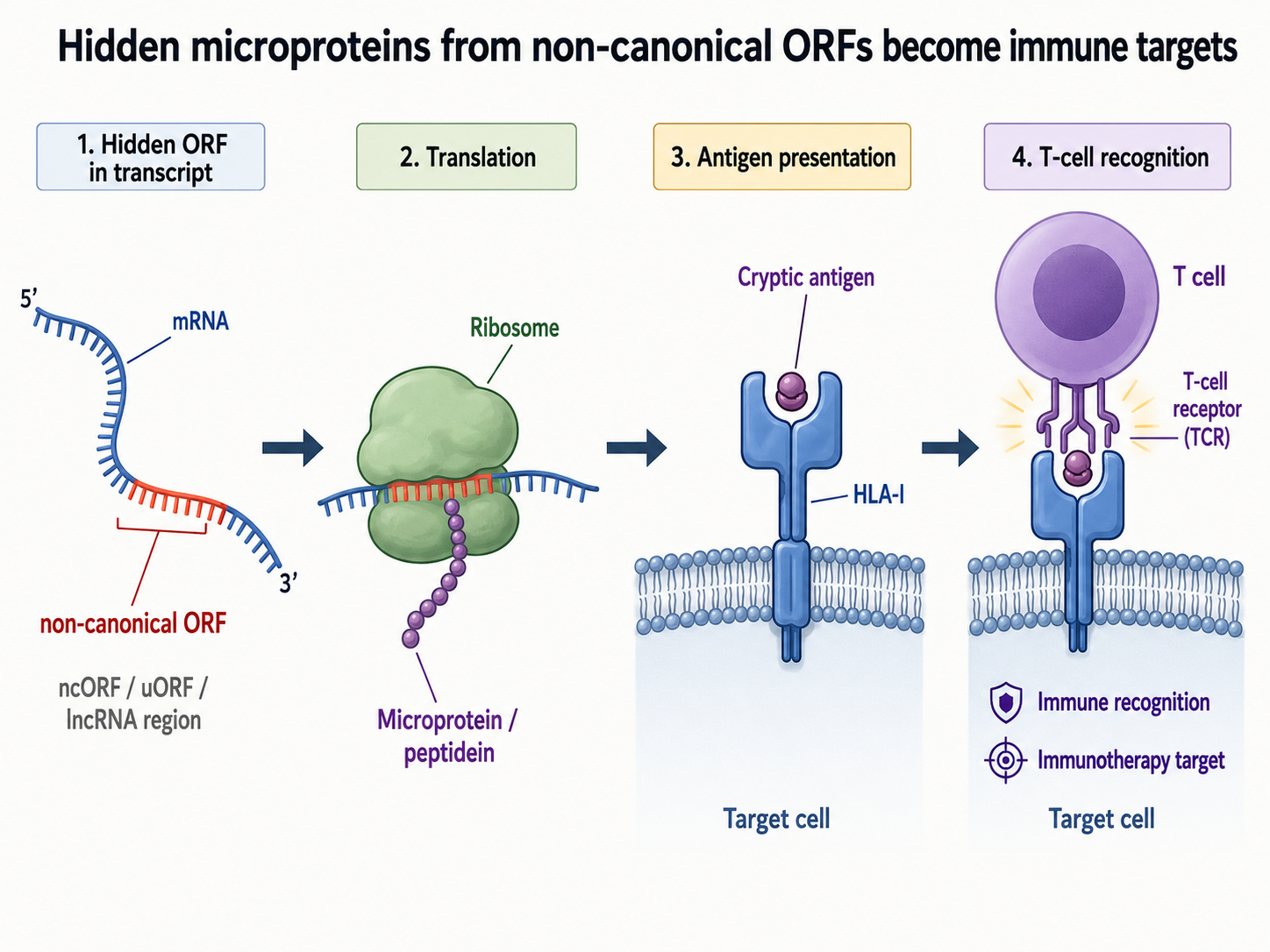
這是一份針對論文《透過微蛋白質與肽蛋白質擴展人類蛋白質組》(Expanding the human proteome with microproteins and peptideins)所做的整理:
前言導讀
長期以來,科學家認為人類的基因組中只有大約 20,000 個「蛋白質編碼基因」,這些基因是構成生命的藍圖。然而,這僅佔了基因組的一小部分,其餘廣大的區域曾被視為不產生蛋白質的「非編碼區」。這篇論文的核心意義在於揭示了一個被忽視的「隱藏世界」——暗蛋白質組(dark proteome)。
過去的研究發現,這些非編碼區其實也會產生微小的蛋白質片段,但科學界一直缺乏嚴謹的標準來定義它們。這就像是在一幅地圖上,我們以前只標註了大城市,卻忽略了無數支撐整體運作的小村莊。這項研究要解決的核心問題是:這些微小片段(稱為微蛋白質)到底有多少是真的存在的?它們是否有生物學功能?
理解這篇論文的關鍵直覺是:生命的設計圖比我們想像中精細得多。它不只有大型的「主力零件」(傳統蛋白質),還充滿了成千上萬個精巧的「微型零件」。這項研究為這些零件建立了第一份權威目錄,讓我們對人類遺傳學的理解從「大致正確」進化到「精確入微」。這對於未來研發精準醫療、癌症疫苗,以及理解罕見疾病的成因至關重要。
完整故事
這篇論文的故事始於科學家對「完整性」的追求。雖然人類基因組計畫已經完成多年,但關於「人體內究竟有多少種蛋白質」的爭論卻從未停止。近年來,許多獨立研究都指出,在那些被標記為「非編碼」的區域中,其實隱藏著數以千計的「非編碼開放閱讀框」(ncORFs),它們似乎正在悄悄地翻譯成微小的蛋白質。
為了確認這些微小線索,一個名為 TransCODE 的國際科學聯盟展開了規模龐大的調查。他們首先蒐集了超過 95,000 個質譜儀(Mass spectrometry)實驗數據,這是一種可以偵測蛋白質實體的技術。接著,他們利用核糖體測序(Ribo-seq)來觀察細胞內的「蛋白質工廠」是否真的在閱讀這些隱藏區域。
研究團隊面臨的最大挑戰在於如何排除「生物噪音」。為了證明這些微蛋白質不是隨機產生的垃圾,他們開發了一套名為 ORBL(ORF relative branch length)的演化分析工具。核心邏輯很簡單:如果一個微小的基因片段在人類與其他 120 種哺乳動物(如猿類、鼠類)的演化過程中都被完整地保留下來,那麼它很可能具有不可或缺的功能。
經過層層過濾,研究人員發現這 7,264 個非編碼片段中,約有 25% 展現了明確的存在證據。為此,他們提出了一個全新的科學名詞:「肽蛋白質」(peptideins)。這個詞用來描述那些已經被證實存在、但我們目前還不確定其具體生理功能的微小分子。它們就像是剛剛被發現的新化學元素,雖然性質尚待研究,但已經正式進入了生命的元素週期表。
研究者更進一步利用 CRISPR 基因編輯技術,像玩樂高積木一樣,把這些微小的零件一個一個「拔掉」,觀察細胞會發生什麼事。結果令人驚訝:他們發現一個位於 OLMALINC 基因區域的肽蛋白質(編號 c10riboseqorf92),竟然是細胞生存所必需的!如果少了它,細胞的細胞分裂(mitosis)和 DNA 修復就會出問題。
這項發現對醫療科學有著重大的意義。在癌症研究中,這些微蛋白質往往會呈現在細胞表面的 HLA 複合物上。由於它們在健康組織和癌組織中的表達可能不同,這為開發「癌症疫苗」或「免疫療法」提供了全新的標靶。此外,許多無法解釋的遺傳疾病,或許答案並不在傳統的大基因裡,而就藏在這些微小的肽蛋白質之中。這篇論文不僅擴展了人類蛋白質的清單,更為未來的生物醫學研究開啟了一扇全新的大門。
Guided Introduction
For decades, the "blueprint of life"—the human genome—was thought to be relatively well-mapped. Scientists identified about 20,000 major genes that provide instructions for making the proteins that build our bodies and keep us alive. Anything outside these areas was often dismissed as "non-coding" or even "junk" DNA because it didn't seem to produce standard proteins. However, this paper matters because it reveals that we have been looking at an incomplete map. It turns out that these supposed "empty" regions are actually teeming with life, producing thousands of tiny, previously invisible molecules called microproteins.
To understand this research, you need to know that proteins are the workhorses of the cell, and until now, our tools were mostly tuned to find "large" workhorses. The core problem this study tackles is the lack of a standardized, rigorous way to identify and classify these tiny molecules. Because they are so small and often exist only briefly, they were frequently dismissed as biological "noise" or accidents.
The key intuition for understanding this paper is to imagine a map of a country that only shows major cities. You might conclude that most of the land is empty. This research is like using a high-powered satellite to suddenly discover thousands of small towns and villages connected by a complex network of roads. Just because a town is small doesn't mean it isn't essential—some of these "small towns" in our genome turn out to be the power plants or communication hubs that the entire country depends on. By establishing a new classification system for these molecules, researchers are finally completing the map of the human "proteome," opening up a "dark" world of biology that could hold the keys to treating cancer and rare genetic diseases.
The Full Story
The story of this research begins with a long-standing scientific mystery: why does so much of our DNA seem to do nothing? For years, a spirited debate has existed about whether the human body contains more than the standard 20,000 proteins. Recent clues suggested that thousands of "hidden" sequences were being translated into tiny proteins, but because they didn't look like typical genes, they weren't officially recognized. This "dark proteome" represented a massive gap in our knowledge of human health.
To solve this, an international group called the TransCODE Consortium decided to hunt for these hidden clues on a global scale. They didn't just look at one or two experiments; they integrated data from over 95,000 different studies. They used two primary "detective tools." First, they used mass spectrometry, a technique that acts like a molecular scale to weigh and identify protein fragments. Second, they used a method called Ribo-seq, which allows scientists to watch the cell's "protein factories" in real-time to see exactly which parts of the DNA they are reading.
However, simply finding a fragment isn't enough to prove it has a purpose. The researchers needed a way to tell the difference between a functional "micro-part" and a random biological mistake. They developed a clever new method called ORBL, which uses evolutionary history as a filter. They reasoned that if a tiny sequence has remained unchanged for millions of years across 120 different mammals—from humans to monkeys to mice—it must be doing something important. If it were just "junk," evolution would have let it mutate or disappear.
Through this massive analysis of 7,264 potential hidden sites, they found that about 25% of them showed solid evidence of producing real protein components. To handle this influx of new data, the team created a new category called "peptideins." These are molecules that we can prove exist, but whose specific "day job" in the body is still being figured out. They also identified a elite group of "Tier 1" microproteins that are so well-supported they deserve to be listed in the official human gene catalog alongside the famous ones we’ve known for decades.
To prove these tiny molecules actually matter, the researchers used "gene scissors" (CRISPR) to snip them out of cells and see what happened. In one striking example involving a transcript called OLMALINC, they found a microprotein that was absolutely essential. When it was removed, the cells couldn't divide properly and their DNA repair systems broke down, eventually leading to cell death. This proved that even the smallest parts of our "dark proteome" can be vital for life.
For science and medicine, this is a game-changer. Many of these microproteins are "seen" by our immune system, meaning they could be used to create highly specific cancer vaccines that teach the body to attack tumors. Furthermore, it suggests that many unexplained genetic diseases might not be caused by mutations in "famous" genes, but in these tiny, overlooked peptideins. We are finally beginning to see the full picture of the human body, revealing a world of complexity that was hidden in plain sight.
這是一份根據原始論文(Nature, 2026)整理的教育性科學導讀,為一般讀者整理的研究摘要:
一句話總結這篇論文
這項研究透過大數據分析與跨國合作,在人類基因組傳統認知的「非編碼區」中發現了數千種微小蛋白質,並建立了「肽蛋白質」(peptideins)新分類,揭開了人類生命藍圖中長期被忽略的隱藏區域。
簡單內容概述
- 研究目的:人類基因組中存在許多被認為不會產生蛋白質的區域。本研究旨在釐清這些「非編碼開放閱讀框」(ncORFs)是否真的會產生微小蛋白質,並為這些新發現的分子建立官方的認證標準與命名系統。
- 做了什麼:
- 整合分析了超過 95,000 個蛋白質組學(質譜儀)實驗。
- 結合了核糖體測序(Ribo-seq)與演化守恆分析(ORBL)。
- 使用基因編輯技術(CRISPR-Cas9)測試這些微小片段對細胞生存是否真的有功能。
- 主要發現:
- 在分析的 7,264 個非編碼區片段中,約 25% 有證據顯示會產生蛋白質成分。
- 提出了 「肽蛋白質」(peptideins) 這一新概念,用來描述那些「已被證實存在,但生理功能尚不明確」的微蛋白質。
- 識別出如 c10riboseqorf92 等微蛋白質,雖然微小,卻是細胞生存所不可或缺的關鍵。
機制邏輯:核心流程步驟
- 地圖掃描:從基因組中標記出潛在的非編碼閱讀框(ncORFs)位置。
- 質譜檢索:在龐大的臨床數據庫中搜尋,看這些位置是否真的被翻譯成了實體的蛋白質片段(肽段)。
- 演化驗證(ORBL):比對人類與其他 120 種哺乳動物,檢查這些序列在演化中是否被刻意保留,這暗示了它們具有生物學功能。
- 分層註釋(Tier system):根據證據強度分級(Tier 1 到 Tier 4),決定哪些該註釋為正式蛋白質,哪些應分類為肽蛋白質(peptideins)。
- 功能實證:對具有潛力的微蛋白質進行基因剔除,確認若缺少它們是否會導致細胞功能異常或死亡。
為什麼重要 / 應用
- 完善人類蛋白質圖譜:揭示了「暗蛋白質組」(dark proteome)的存在,這意味著人類的生理機制遠比目前教科書寫的還要複雜。
- 癌症免疫治療:許多微蛋白質片段會呈現在細胞表面的 HLA 複合物上,這能成為癌症疫苗或免疫療法的新標靶。
- 遺傳病研究:許多致病突變可能就發生在這些新發現的微小蛋白質區域,而非傳統的知名基因中。
需要記住的關鍵名詞
- 非編碼開放閱讀框 (ncORFs):基因組中以前被認為像「垃圾」一樣不會產生蛋白質的區域。
- 微蛋白質 (Microproteins):由短小的 ncORFs 翻譯而成的小分子量蛋白質,過去常因技術限制而被忽略。
- 肽蛋白質 (Peptideins):這項研究提出的新名詞。指那些已被實驗確認產生、但我們還不確定它在正常身體裡具體做什麼的微蛋白質。
- 暗蛋白質組 (Dark Proteome):指人類基因組中尚未被正式命名或研究,但卻實際存在的蛋白質「隱藏版」。
- ORBL (ORF Relative Branch Length):本研究開發的新工具,用來測量一段 DNA 序列在各物種演化過程中,維持能產出蛋白質「潛力」的程度。
This summary is based on the research paper "Expanding the human proteome with microproteins and peptideins" published in Nature (2026).
One-Sentence Summary
This study identifies and classifies thousands of previously "hidden" microproteins in the human genome, revealing a vast and functional "dark proteome" that is essential for cellular life and human health.
Overview
- Research Goal: To move beyond the standard list of 20,000 human genes and identify "non-canonical" microproteins that have been overlooked because they are produced from regions of DNA previously thought to be "non-coding."
- What They Did:
- Integrated data from over 95,000 proteomics (protein-fragment weighing) experiments.
- Analyzed "protein factories" in cells (Ribo-seq) to see which hidden DNA instructions were being read.
- Developed a new evolutionary tool called ORBL to see if these tiny sequences were preserved across 120 different mammals.
- Used "gene scissors" (CRISPR) to delete these microproteins and observe the effect on living cells.
- Main Findings:
- Confirmed that about 25% of the 7,264 suspected hidden regions actually produce protein components.
- Officially identified peptideins, a new class of microproteins that are proven to exist even if their exact biological "job" is not yet fully understood.
- Discovered that some of these tiny molecules, such as one found in the OLMALINC transcript, are essential for cell survival; without them, cells cannot divide or repair their DNA.
Mechanism Logic: How the Research Worked
- Scanning the "Dark" Areas: The team first mapped out thousands of "Open Reading Frames" (ncORFs)—segments of DNA that have the right structure to make a protein but weren't on the official maps.
- Searching for Physical Evidence: They searched through massive global databases of protein fragments (mass spectrometry) to see if any of these segments were actually being turned into physical molecules in human tissues.
- Checking the Evolutionary Clock: They used the ORBL tool to compare these human sequences with 120 other mammals. If a sequence has remained unchanged for millions of years, it likely serves a vital purpose.
- Creating the Catalog: Based on the strength of the evidence, they sorted these discoveries into "Tiers." The most certain ones were proposed as new human genes, while others were labeled as peptideins.
- Proving Life-or-Death Importance: Finally, they used CRISPR to "knock out" specific microproteins in laboratory cells. By showing that cells died or malfunctioned without them, they proved these tiny molecules are not biological accidents but critical components of life.
Why It Matters / Applications
- Cancer Immunotherapy: Many of these microproteins are "shown" to the immune system on the surface of cells. Because they may appear differently in tumors, they could be used to create highly precise cancer vaccines.
- Solving Medical Mysteries: Many genetic diseases remain unexplained because mutations aren't found in "famous" genes; this research suggests the cause might lie in these hidden microproteins.
- Completing the Human Blueprint: By identifying the "dark proteome," scientists can finally understand the full complexity of how a human cell operates, leading to better drugs and treatments.
Key Terms to Remember
- ncORF (Non-canonical Open Reading Frame): A segment of DNA previously thought to be "junk" or non-coding that actually contains instructions for making proteins.
- Microprotein: A very small protein molecule that was historically ignored by scientists due to its size.
- Peptidein: A newly coined term for a microprotein that has been experimentally proven to exist, even if its specific function is still being studied.
- Dark Proteome: The vast collection of hidden proteins in the human body that have not yet been officially named or cataloged.
- ORBL (ORF Relative Branch Length): A scoring method that measures how well a tiny protein sequence has been "saved" by evolution across different species.
Deutsch EW, Kok LW, Mudge JM, et al. Expanding the human proteome with microproteins and peptideins. Nature (2026).
DOI: 10.1038/s41586-026-10459-x · 閱讀全文 →Read full text →
本頁為教育性整理,非原文翻譯;原文版權屬原出版方。An educational summary, not a translation; copyright remains with the original publisher.