這是一份為一般讀者整理的論文導讀與故事性總結,旨在將艱深的研究轉化為易於理解的概念。
前言導讀
想像一下,你的身體是一座由無數精密工廠(細胞)組成的城市,而粒線體(Mitochondria)就是這些工廠裡的「發電機」。這篇論文聚焦於發電機中一個最核心的組件:呼吸鏈複合體 I(MCI)。當這個組件發生故障時,細胞不僅會面臨能源短缺,還會排放出大量像廢氣一樣的有害物質——活性氧(ROS)。
過去科學界認為,粒線體壞了就是單純的「斷電」和「中毒」,導致神經與肌肉退化。但這項研究揭示了一個令人驚訝的真相:身體的不同組織在面對發電機故障時,反應竟然完全相反。
神經系統展現了驚人的韌性,它會利用「廢氣」(ROS)作為警報,啟動備用計畫來維持功能;然而,肌肉系統卻對這些廢氣毫無抵抗力,迅速崩潰。這項研究的核心意義在於,它幫我們釐清了為什麼粒線體相關疾病(如罕見的萊氏症候群 Leigh syndrome)會同時對大腦和體力產生如此複雜且多樣的破壞,並為未來的精準醫療鋪路。
理解這篇論文的關鍵直覺在於:活性氧不只是細胞的毒藥,有時它更像是一封急件,提醒神經系統在斷電前趕快啟動備援。
完整故事
這篇科學故事的起源,來自於醫學界對粒線體疾病的困惑。粒線體是生命能量的來源,當它出問題時,通常會導致嚴重的神經退化和肌肉萎縮。研究團隊想知道:在神經與肌肉交會的關鍵地帶——神經肌肉接點(NMJ),當電力系統真的崩潰時,究竟發生了什麼事?
追蹤線索:果蠅工廠的模擬實驗
為了找出答案,研究者選擇了與人類基因高度相似的果蠅作為實驗對象。他們利用精密基因技術,像開關一樣有目的地關掉果蠅神經或肌肉裡的 MCI 組件(主要是針對 NDUFS7 基因)。隨後,他們在顯微鏡下觀察到一個奇怪的現象:神經裡的粒線體雖然變得又少又小,分布也亂七八糟,但這群果蠅的神經傳導功能竟然幾乎正常!
神經端的逆境求生:化危機為轉機
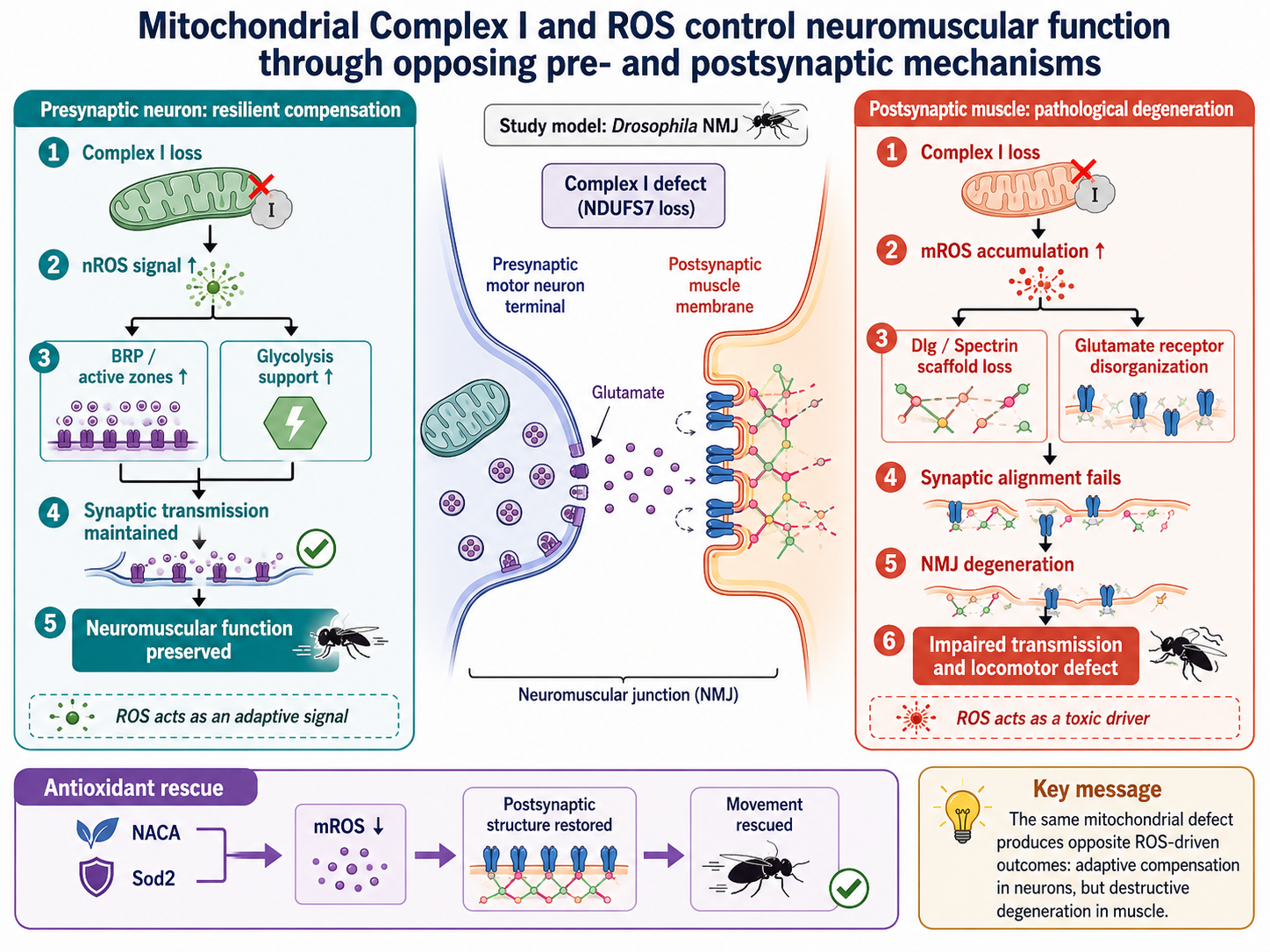
研究者深入調查發現,神經端在偵測到粒線體故障後,會產生大量的活性氧。但神奇的是,這些活性氧在這裡扮演了「信使」的角色。它觸發了一套恆定補償機制(Homeostatic Compensation),讓神經端在訊息釋放處(稱為「活動區」Active Zone)堆放更多的補強蛋白質(如 Bruchpilot,簡稱 BRP),並且啟動另一套不依賴粒線體的能源系統(糖解作用,Glycolysis)。簡單來說,神經系統在電力不足時,靠著「廢氣」發出的警報,自動升級了硬體設備,確保訊號依然能傳遞出去。
肌肉端的全面崩塌:毫無防備的受害者
然而,當研究者把同樣的故障移到肌肉端時,故事卻變成了悲劇。肌肉端產生的活性氧完全是破壞性的。這些物質毀掉了肌肉表面的支架(稱為 Dlg 蛋白),導致接收神經訊號的受體像地震後的房子一樣倒塌、散開。結果,神經傳出的訊息再強,肌肉也接不到。這些果蠅因此出現了嚴重的運動障礙,連爬行都有困難。
科學與醫療的救贖:找到精準的解藥
為什麼兩者的結局差這麼多?研究者發現關鍵在於活性氧的處理方式。他們嘗試給果蠅服用一種強力的抗氧化劑(NACA),或者透過基因手段增加細胞內清除廢氣的「清潔工」(Sod2 酵素)。結果令人振奮:原本癱瘓的肌肉結構竟然恢復了,果蠅的運動能力也回到了正常水準。
對醫療的啟示
這項發現對未來的科學與醫療有著重大意義。首先,它告訴我們,治療粒線體疾病不能「亂槍打鳥」地全面抗氧化,因為在神經端,適度的活性氧可能是保護功能的訊號。其次,它精確指出了肌肉端的脆弱性,並證明了針對粒線體內部的特定抗氧化治療,有潛力修復因代謝功能障礙而引起的肌肉退化症。這為我們打開了一扇窗,讓我們看到未來如何透過調節細胞內的「化學警報」,來對抗原本無藥可醫的遺傳疾病。
Guided Introduction
Imagine your body as a high-tech city where every building depends on specialized power plants called mitochondria. These plants produce the energy (ATP) required for everything from thinking to moving. This paper focuses on a specific part of that power plant called Mitochondrial Complex I (MCI). When this component breaks down, it doesn't just stop producing power; it also begins leaking a volatile byproduct called Reactive Oxygen Species (ROS)—essentially "cellular smoke."
In humans, failures in these power plants lead to devastating conditions like Leigh syndrome, which causes muscles to waste away and the nervous system to fail. For a long time, scientists assumed that mitochondrial failure was a simple story of "the lights going out." However, this research reveals a much more nuanced reality: our cells don't just sit in the dark; they react to the failure in wildly different ways depending on where they are.
The core problem this study tackles is why mitochondrial diseases affect different parts of the body so inconsistently. Why does a nerve survive while a muscle dies? The key intuition for understanding this paper is to view ROS not just as a toxic waste product, but as a potential alarm signal. In the nervous system, this "smoke" acts as a warning that triggers a backup plan. In the muscular system, however, the same smoke acts like a corrosive acid, dissolving the very structures that allow the brain to communicate with the body. Understanding this "ROS paradox" is the first step toward developing treatments that don't just broadly fight toxins, but specifically target how different tissues handle crisis.
The Full Story
The story begins with a medical mystery: why do genetic mutations in mitochondria cause such a chaotic range of symptoms? To find out, researchers turned to a classic scientific ally—the fruit fly (Drosophila). Though they seem simple, fruit flies share an ancient genetic blueprint with humans, making them perfect models for studying how nerves and muscles interact at a "communication hub" known as the neuromuscular junction.
The researchers started by using a genetic "dimmer switch" (a technique called RNAi) to specifically break the Mitochondrial Complex I in either the flies' motor neurons or their muscles. They expected that regardless of where they flipped the switch, the fly would stop moving. What they found instead was a tale of two different cellular fates.
When the researchers broke the power plants in the nerves, they saw something incredible. Despite having fewer and smaller mitochondria, the nerves continued to send strong signals to the muscles. They discovered that the "smoke" (ROS) produced by the failing mitochondria was acting as a messenger. It told the nerve to beef up its transmission sites—essentially building more "docks" for chemical signals to be shipped out. To keep the lights on without their main power plants, these nerves also shifted their metabolism to burn sugar directly through a process called glycolysis. In short, the nerve sensed the crisis and adapted to stay functional.
However, the story turned dark when the researchers broke the power plants in the muscles. In this scenario, the ROS did not act as a helpful alarm. Instead, it behaved like a destructive force, tearing down the scaffolding proteins (like Dlg and Spectrin) that hold the muscle's "ears" (receptors) in place. Even if the nerve shouted at full volume, the muscle couldn't hear it because its receiving equipment had melted away. These flies became weak and lost their ability to crawl.
The final chapter of this story offers a glimmer of hope for medicine. The researchers found that they could actually "rescue" the failing muscles. By giving the flies a specialized antioxidant called NACA or by genetically boosting a cleanup enzyme called Sod2, they were able to scrub away the toxic ROS. Once the "smoke" was cleared, the muscle scaffolds stabilized, the receptors returned to their proper places, and the flies regained their ability to move.
For science and medicine, this means that treating mitochondrial disease isn't a one-size-fits-all task. We cannot simply try to shut down all ROS, as some of it might be helping our nerves stay resilient. Instead, this research points toward a future of "precision antioxidants"—treatments that go exactly where the damage is happening to protect our muscles and stabilize our nervous system's natural defense mechanisms.
這是一份根據引用文獻整理的教育性科學導讀,為一般讀者整理的研究摘要:
一句話總結
這項研究發現,當細胞能量工廠「粒線體」功能受損時,在神經系統中會觸發自我保護的補償機制維持功能,但在肌肉系統中則會導致嚴重的結構破壞與運動障礙。
簡單內容概述
- 研究目的:探討粒線體呼吸鏈複合體 I (Mitochondrial Complex I, MCI) 功能缺失時,神經與肌肉分別如何應對,以及「活性氧」(ROS) 在其中的角色。
- 做了什麼:研究人員以果蠅為實驗對象,利用基因技術精確地減少其神經或肌肉中的 MCI 關鍵亞基(主要是 NDUFS7),並觀察對「神經肌肉接點」(NMJ) 結構與功能的影響。
- 主要發現:
- 神經端具韌性:神經中的粒線體缺陷雖然會改變粒線體分布,但透過過量產生的 ROS 作為訊號,神經會自動「加強」傳導位點,使功能保持正常。
- 肌肉端易受損:肌肉中的粒線體缺陷產生的 ROS 則具有破壞性,會導致突觸萎縮、肌肉結構混亂、神經訊號傳導失效。
- 抗氧化救星:使用特定的抗氧化劑(如 NACA)或清除 ROS 的酵素(如 Sod2),可以成功逆轉肌肉的退化並修復運動能力。
機制邏輯(因果順序)
神經端的補償流程(預防功能喪失):
- 缺陷發生:人為減少神經中的 MCI 功能。
- 產生訊號:粒線體產生過量的活性氧 (nROS)。
- 啟動機制:過量 ROS 並未殺死神經,反而像警報器般觸發補償反應。
- 結構補強:增加神經釋放訊號區域的蛋白質(如 BRP)含量,讓剩餘的功能發揮最大效用。
- 能量支援:同時利用「糖解作用」(Glycolysis) 作為替代能源。
- 結果:神經訊號強度維持正常,功能穩定。
肌肉端的破壞流程(病理退化):
- 缺陷發生:人為減少肌肉中的 MCI 功能。
- 毒素累積:肌肉粒線體產生過量的活性氧 (mROS)。
- 結構解體:過量 ROS 破壞了肌肉端的支架蛋白(如 Dlg/Spectrin)和受體分布。
- 接點斷開:神經與肌肉的訊號對準失效(受體缺失)。
- 結果:突觸退化、神經傳導失靈、果蠅爬行能力喪失。
為什麼重要 / 應用
- 理解疾病機制:這項研究解釋了粒線體相關疾病(如人類的 Leigh 症候群)為何在不同組織會產生不同的病理特徵。
- ROS 的雙重角色:揭示了活性氧不只是細胞毒素,在特定情況下也是重要的調節訊號。
- 精準治療思路:未來針對粒線體缺失引起的肌肉萎縮或神經退化,可能透過針對性地清除粒線體內的特定 ROS(如使用 NACA)來達到治療效果。
需要記住的關鍵名詞
- 粒線體呼吸鏈複合體 I (Mitochondrial Complex I, MCI):細胞產生能量(ATP)的重要組件,功能障礙與多種遺傳疾病有關。
- 活性氧 (Reactive Oxygen Species, ROS):細胞代謝的化學副產物,過量時會造成損傷,但在本研究中也充當神經補償的訊號分子。
- 神經肌肉接點 (Neuromuscular Junction, NMJ):運動神經與肌肉纖維之間的溝通橋樑,負責控制身體所有運動。
- 恆定補償機制 (Homeostatic Compensation):生物體在面對功能缺陷時,自動啟動的自我平衡反應,以維持系統運作。
- 抗氧化劑 NACA (N-Acetyl Cysteine Amide):一種能穿過細胞膜並進入粒線體清除過量 ROS 的藥物,在本研究中能修復肌肉功能。
This summary, based on the provided research paper, explains how a breakdown in a cell’s energy production affects the communication between nerves and muscles.
One-Sentence Summary
This study reveals that when cellular "power plants" fail, the nervous system activates a protective backup plan to maintain function, whereas the muscular system suffers structural collapse and failure.
Overview
- Research Goal: To determine how different tissues (nerves vs. muscles) respond when Mitochondrial Complex I (MCI)—a critical component of the cell's energy factory—stops working.
- What They Did: Researchers used fruit flies as a model, using genetic tools to selectively disable MCI in either the motor neurons or the muscles. They then used advanced imaging and electrical recordings to see how these changes affected the Neuromuscular Junction (NMJ), the site where nerves tell muscles to move.
- Main Findings:
- Resilient Nerves: When MCI fails in nerves, they don't stop working. Instead, they use a "smoke signal" (Reactive Oxygen Species) to trigger a compensation mechanism that keeps signals strong.
- Vulnerable Muscles: When the same failure happens in muscles, it is destructive. The "smoke" dissolves the muscle's structural supports and hides its signal receptors.
- Antioxidant Rescue: Researchers found that specific antioxidant treatments could scrub away this toxic "smoke," repairing muscle damage and restoring the flies' ability to crawl.
Mechanism Logic
In the Nerves (The Protective Response):
- Failure: MCI function is lost, causing mitochondria to shrink and cluster.
- Signal: These failing mitochondria leak Reactive Oxygen Species (ROS).
- Alarm: In nerves, ROS acts as an alarm rather than a poison.
- Backup: The nerve responds by piling up extra transmission proteins (like Bruchpilot) at its signaling sites and switching its energy source to sugar-burning (glycolysis).
- Result: The nerve successfully delivers its message to the muscle despite the "power outage."
In the Muscles (The Destructive Response):
- Failure: MCI function is lost in the muscle tissue.
- Damage: The resulting buildup of ROS behaves like a corrosive acid.
- Collapse: This "chemical smoke" destroys the scaffolding proteins (like Dlg) that hold the muscle's receptors in place.
- Disconnection: Without its receptors properly aligned, the muscle cannot "hear" the nerve's instructions.
- Result: The synapse degenerates, leading to weakness and loss of movement.
Why It Matters / Applications
- Understanding Disease: This research helps explain why mitochondrial diseases, such as Leigh syndrome, cause such a wide and confusing variety of symptoms in humans.
- Precision Medicine: It suggests that broad antioxidant treatments might be counterproductive because some "toxic" molecules actually help nerves survive.
- New Treatments: The study identifies specific antioxidants (like NACA) that can cross into cells and protect muscles, offering a potential path for future therapies for metabolic and degenerative diseases.
Key Terms to Remember
- Mitochondrial Complex I (MCI): A core part of the cell's energy-producing machinery.
- Reactive Oxygen Species (ROS): Chemically reactive molecules produced by mitochondria; they can be harmful toxins or helpful signals depending on the context.
- Neuromuscular Junction (NMJ): The critical "bridge" where nerve signals are converted into muscle movement.
- Active Zone: The specific spot on a nerve terminal where chemical messages are shipped out to the muscle.
- Homeostasis: The body's ability to maintain a stable, functional state even when something goes wrong.
- NACA (N-Acetyl Cysteine Amide): A specialized antioxidant that can enter cells to neutralize harmful ROS and was shown to rescue muscle function in this study.
Mallik B, Bhat SA, Wang X, Frank CA (2025) Mitochondrial Complex I and ROS control neuromuscular function through opposing pre- and postsynaptic mechanisms. PLoS Biol 23(9): e3003388. https://doi.org/10.1371/journal.pbio.3003388
DOI: 10.1371/journal.pbio.3003388 · 閱讀全文 →Read full text →
本頁為教育性整理,非原文翻譯;原文版權屬原出版方。An educational summary, not a translation; copyright remains with the original publisher.