1
類澱粉形成Amyloid formation
錯誤摺疊的 α-synuclein 單體聚集,組裝成排列有序的類澱粉纖維。Misfolded α-synuclein monomers assemble into ordered amyloid fibrils.
α-突觸核蛋白類澱粉不只是被動的堆積物,它可能像酵素一樣,不可逆地分解 ATP 與其他核苷酸,把蛋白質聚集與神經元能量耗竭連在一起。α-synuclein amyloid fibrils may act like catalytic surfaces that degrade ATP and other nucleotides, linking protein aggregation to neuronal energy failure.
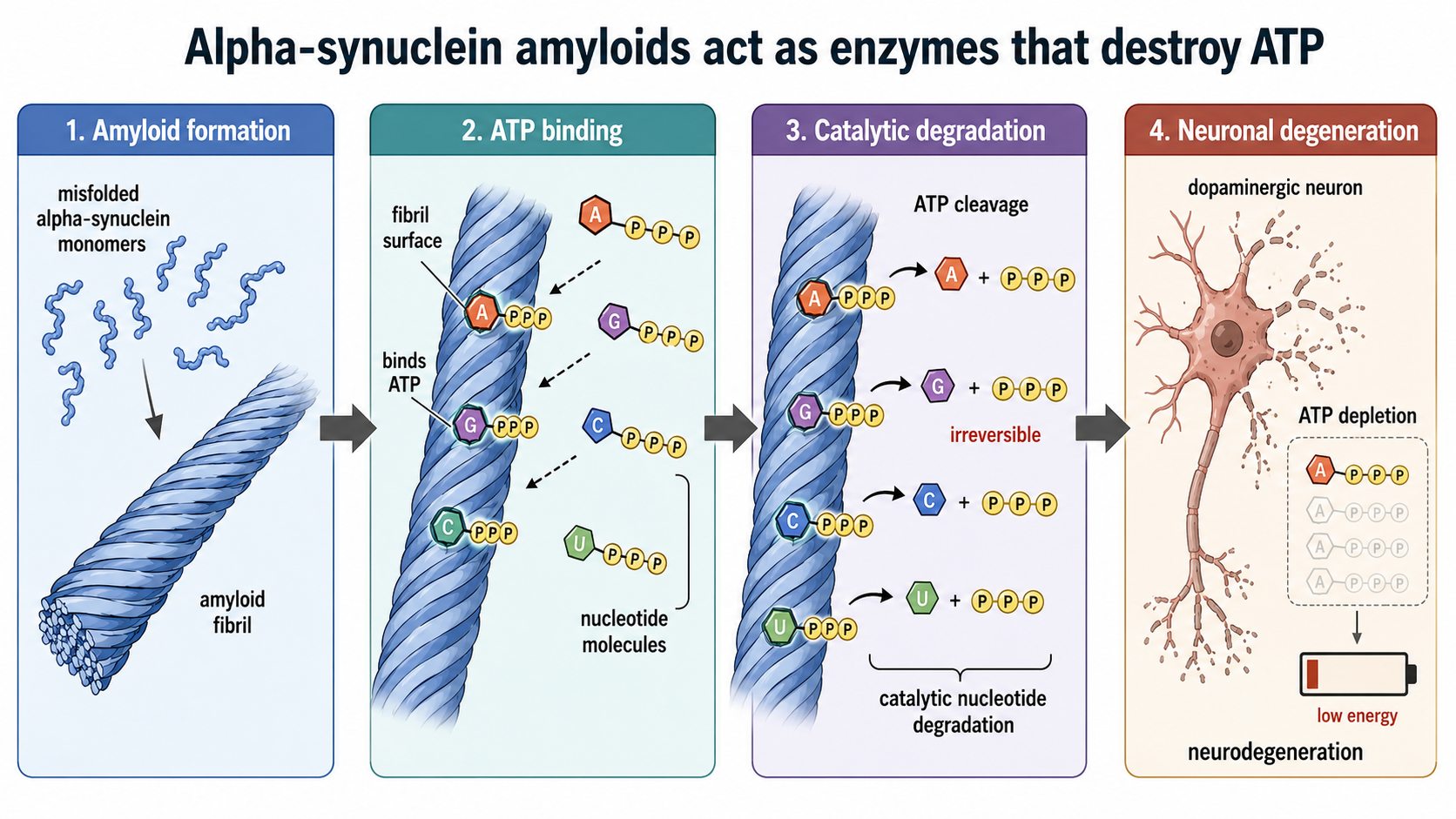
錯誤摺疊的 α-synuclein 單體聚集,組裝成排列有序的類澱粉纖維。Misfolded α-synuclein monomers assemble into ordered amyloid fibrils.
纖維表面提供重複排列的化學結構,能結合 ATP 與相關核苷酸。The fibril surface provides repetitive chemical features that can bind ATP and related nucleotides.
被結合的 ATP 依序被降解為 ADP、AMP,並進一步形成 inosine 等產物。Bound ATP is degraded through ATP → ADP → AMP and further products such as inosine.
持續的核苷酸降解可能導致細胞能量耗竭,使神經元更容易受損。Persistent nucleotide degradation may contribute to cellular energy depletion and neuronal vulnerability.
重要提醒:Important caution: 此處多數機制證據屬於生化/體外(in vitro)實驗,對細胞與活體疾病的關聯仍需審慎解讀。Most mechanistic evidence here is biochemical / in vitro. Cellular and in vivo disease relevance should be interpreted cautiously.
這篇研究指出,帕金森氏症相關的 α-synuclein amyloid 不只是細胞中被動的堆積物。它們的纖維表面可能形成一種具類酵素活性的催化平台,直接捕捉並降解 ATP 與其他 nucleotides。因此,蛋白質聚集可能不只是物理阻塞,而是主動破壞細胞能量供應——為 amyloid pathology 與神經元能量耗竭之間,提供了一條新的機制連結。This study suggests that Parkinson’s disease-related α-synuclein amyloids are not merely passive aggregates. Their fibril surfaces may behave like catalytic platforms that degrade ATP and other nucleotides — reframing amyloid toxicity as an active biochemical process that may connect protein aggregation to neuronal energy failure.
帕金森氏症的核心病理,是 α-突觸核蛋白(α-synuclein)異常聚集成「類澱粉(amyloid)」纖維,並毒害負責動作控制的多巴胺神經元,臨床上常見「路易氏體(Lewy bodies)」。長期以來的謎團是:這些蛋白質塊究竟如何導致神經細胞死亡。
這些類澱粉堆積物只是被動的「細胞垃圾」,還是本身具有主動的化學(類酵素)活性,會直接參與破壞細胞代謝?
研究團隊在實驗室人工培育出純淨的 α-synuclein 類澱粉纖維,與 ATP 及其他核苷酸混合,再用高效液相層析(HPLC)追蹤降解產物的變化(屬體外實驗)。
這些纖維展現「催化能力」:像酵素一樣將 ATP 依序降解為 ADP、AMP,最終形成 inosine 等低能量產物;長時間作用下 ATP 幾乎被完全消耗(可達約 99%)。除 ATP 外,GTP、CTP、UTP 等核苷酸也會被降解,且在類似溶酶體的酸性環境中仍保有活性。
這把蛋白質毒性重新定義為一種「主動的化學攻擊」(gain-of-function toxicity),可能解釋為何最耗能的神經元最先死亡,並為類澱粉病理與神經元能量耗竭之間提供可能的生化連結。
目前證據主要來自生化/體外實驗;要確認在活細胞與人體疾病中的真實角色,仍需更多細胞與活體層級的驗證。
Parkinson’s disease is defined by the death of dopamine-producing neurons. The protein α-synuclein misfolds and clumps into tough fibers called amyloids (seen as Lewy bodies). How exactly these clumps kill brain cells had remained a long-standing mystery.
Are these amyloids merely passive aggregates, or do they possess an active, enzyme-like chemical activity that directly disrupts cellular metabolism?
The team grew purified α-synuclein amyloid fibrils in the lab, incubated them with ATP and other nucleotides, and used high-precision liquid chromatography (HPLC) to track the degradation products over time (an in-vitro setup).
The fibrils acted like catalysts: ATP was systematically degraded ATP → ADP → AMP and on to low-energy products such as inosine, with near-complete (up to ~99%) ATP loss over time. Other nucleotides (GTP, CTP, UTP) were also degraded, and the activity persisted even in acidic, lysosome-like conditions.
This reframes amyloid toxicity as an active chemical attack (a gain-of-function toxicity), offering a possible reason why the most energy-hungry neurons die first, and a candidate biochemical link between amyloid pathology and neuronal energy depletion.
The evidence is mainly biochemical / in vitro. Confirming the real role in living cells and human disease will require further cellular and in-vivo validation.
Castillo-Cáceres, C. et al. Alpha-synuclein amyloids catalyze nucleotide degradation. Scientific Reports (2025).
本頁為教育性整理,非原文翻譯;原文版權屬原出版方。An educational summary, not a translation; copyright remains with the original publisher.