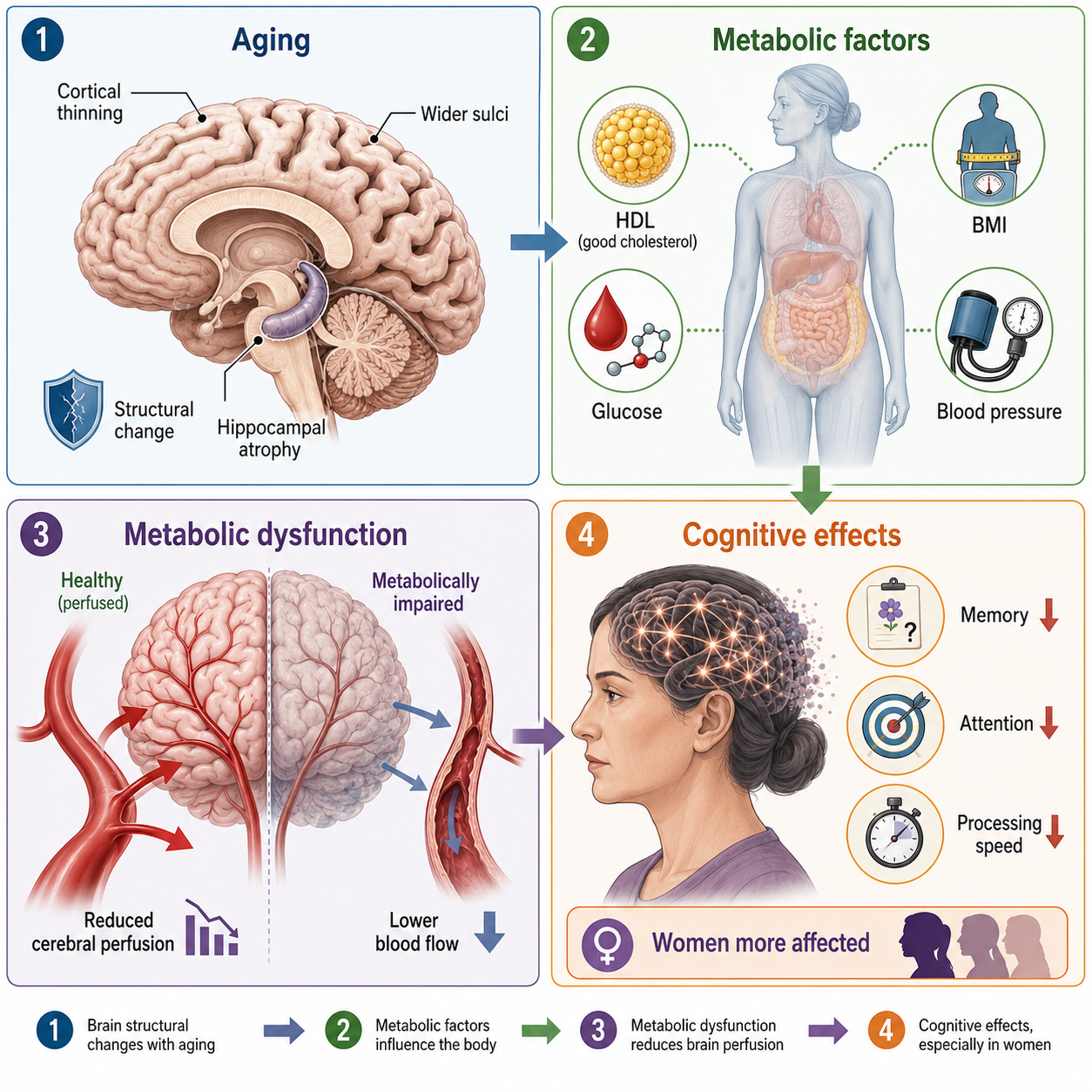
這是一份為大眾讀者整理的科普導讀,幫助您理解這項關於大腦健康與身體代謝之間關聯的重要研究。
前言導讀
長期以來,醫學界傾向於將「大腦」與「身體」視為兩個獨立的系統來研究。當我們談論大腦老化時,往往只關注年齡帶來的影響,卻忽略了血液中的生化指標、血壓和體重等「周邊生理特徵」如何實時反映大腦的健康狀態。這篇論文的重要性在於,它打破了這種隔閡,揭示了大腦健康受兩條完全獨立的路線影響:一條是不可避免的「年齡增長」,另一條則是我們可以控制的「代謝狀態」。
讀者需要先建立一個關鍵直覺:想像大腦是一座運作中的工廠,「老化」像是廠房建築結構隨時間自然損耗(例如牆壁變薄、梁柱老化);而「代謝功能障礙」則像是電力與供水系統的失靈(血液供應不足)。這項研究解決的核心問題是:代謝不良究竟只是加速了老化,還是對大腦造成了另一種獨特的傷害?研究結果明確指出,這兩者是分開運作的。這意味著,即使我們無法停止年齡增長,但透過改善代謝健康(如控制血糖、血壓與體重),我們依然能為大腦爭取到額外的保護空間。
完整故事
問題的起源:大腦與身體的斷裂
過去,科學家雖然知道肥胖或高血壓對身體不好,但在研究大腦萎縮或認知退化時,往往將這些身體指標視為「背景雜訊」,或者簡單地認為它們只是讓大腦老得更快而已。然而,臨床醫生卻經常觀察到,某些年紀相同的人,大腦健康程度卻有天壤之別。這讓研究團隊開始思考:在年齡之外,是否有一套獨立的身體生理密碼,正直接決定著大腦的優劣?
尋找線索:海量數據的跨國比對
為了找出答案,研究人員分析了兩組極為詳盡的數據庫(HCP-Aging 與 UK Biobank),涵蓋了數千名受試者。他們不只看單一指標,而是將數十種身體數值(包括體重 BMI、血壓、血糖、血脂、肝功能指標等)與多種先進的大腦核磁共振影像(MRI)結合起來。這些影像能看見大腦的結構厚度、神經纖維的完整性,以及最重要的——大腦血液灌流 (Cerebral blood perfusion)。
研究方法:找出連動的模式
研究團隊使用了一種稱為「偏最小二乘法」(Partial Least Squares) 的統計技術。這種方法厲害的地方在於它能像特種部隊一樣,從成千上萬個特徵中,抓出哪些身體指標與哪些大腦變化是「同生共死」的。
核心發現:兩條平行的傷害路線
研究結果驚人地發現,大腦健康主要由兩個獨立的「軸線」構成:
- 老化軸 (Aging axis):這主要與年齡有關。隨著變老,大腦皮質會變薄,神經傳導的「電線」會磨損,且血液從血管運送到腦組織的時間會變長。這是大腦「結構性」的衰退。
- 代謝軸 (Metabolic axis):這主要由高血糖(HbA1c)、高血壓、體重過重、低「好膽固醇」(HDL) 及肝指標異常組成。最關鍵的發現是:代謝越差的人,大腦的血流量(灌流)就越低。
研究最震撼的結論是:這兩條軸線是互不隸屬的。換句話說,代謝不良對大腦造成的「貧血」傷害,並不是因為它讓你變老,而是它開闢了另一條損害大腦的戰場。
這對我們意味著什麼?
這項研究為科學與醫療帶來了三個層面的啟示:
- 預防勝於治療:老化難以逆轉,但代謝狀態(如飲食、運動、藥物控制血糖血壓)是可干預的。只要維持良好的代謝,即便年歲增長,仍能維持較佳的大腦血流與認知功能。
- 性別差異的關注:研究發現,女性的大腦對代謝紊亂特別敏感。代謝不良的女性在「認知靈活性」(即處理複雜任務、隨機應變的能力)上會出現更明顯的下降。
- 新的健康指標:未來大腦健康的評估,不應只看年齡或簡單的掃描,透過監測血液中的生化指標,我們就能預測大腦是否正處於「缺血」的風險中。
總結來說,這篇論文告訴我們:守護你的代謝指標,就是在守護你腦中的血流量,進而保護你的思考能力。
This response provides a simplified, narrative overview of the research paper "Aging and metabolism contribute separately to brain–body health," designed for a general audience.
Guided Introduction
For decades, the fields of neuroscience and general medicine have largely operated in silos. When we talk about the aging brain, we usually focus on the "clock"—the inevitable passage of time that thins the cortex and slows our thinking. We treat body-wide issues like high blood pressure or obesity as separate "lifestyle" problems that might make things worse, but we haven't fully understood if they are just accelerating the clock or if they are attacking the brain through a completely different pathway. This paper matters because it proves that metabolic health is not just a passenger of aging; it is a driver in its own right.
To understand this, you need to think of your brain like a high-end data center. To stay healthy, it needs two things: a solid physical structure (the building and the servers) and a constant, high-quality power and cooling supply (the utilities). Aging is like the natural wear and tear on the building’s structure over decades. Metabolic dysfunction—which includes things like high blood sugar, poor cholesterol, and high blood pressure—is like a faulty power grid that fails to deliver the necessary resources to the servers.
The core problem the researchers tackled was determining whether these two "damage types" are actually the same thing. By looking at thousands of people, they discovered that even if you compare two people of the exact same age, the one with poor metabolic health has a brain that is struggling in a very specific, unique way: it is starving for blood flow. This provides a powerful "on-ramp" for understanding brain health: while we cannot stop the passage of time, we can maintain the "utilities" of the brain by managing our body’s metabolism.
The Full Story
The story began with a simple observation: some people age "better" than others. Doctors noticed that while age is the biggest risk factor for brain decline, individuals with similar birth years often have vastly different levels of cognitive health. Researchers suspected that "peripheral" biomarkers—the clues found in our blood and physical measurements—held the secret. They wanted to see if things like your body mass index (BMI), blood pressure, and blood sugar levels were speaking a secret language that the brain was listening to.
To find these clues, the team turned to two of the world’s most comprehensive health databases: the Human Connectome Project–Aging and the UK Biobank. These repositories contain a treasure trove of data, combining advanced brain scans (MRI) with detailed blood and urine tests from thousands of volunteers. Instead of looking at just one marker at a time—like just looking at sugar or just looking at memory—the researchers used a sophisticated statistical technique called "multivariate pattern learning." This allowed them to see how groups of body markers "dance" together with groups of brain features.
What they found was a clear divide between two distinct paths of decline. The first path is the Aging Axis. As the years pass, the brain naturally loses some of its structural integrity; the outer layer (the cortex) gets thinner, and the "wiring" (white matter) becomes less efficient. This is the structural wear-and-tear we expect with time.
However, a second, independent path emerged: the Metabolic Axis. This path is defined by a specific "profile" of body markers: high BMI, high blood pressure, elevated blood sugar (HbA1c), and low "good" cholesterol (HDL). The researchers discovered that this metabolic profile is the primary enemy of Cerebral Blood Perfusion—essentially, the amount of blood flow reaching the brain tissue. When your metabolism is out of balance, your brain’s "plumbing" struggles to deliver oxygen and nutrients, even if your brain structure hasn't fully "aged" yet.
Crucially, the study proved that the metabolic path is independent of the aging path. This means that metabolic damage isn't just "early aging"; it’s a separate assault on the brain. They even found that these metabolic issues directly translate to real-world consequences, such as reduced "cognitive flexibility"—the ability to switch between tasks or solve new problems. This was particularly noticeable in female participants, suggesting that women’s brains might be especially sensitive to these metabolic shifts.
For the world of science and medicine, this discovery is a beacon of hope. Since metabolism is largely influenced by lifestyle—what we eat, how much we move, and how we manage our blood pressure—it means that brain health is partially within our control. Even as we get older, we can protect our brain’s blood supply and cognitive sharpness by keeping our body’s metabolic numbers in check. It shifts the conversation from "coping with an aging brain" to "actively maintaining a healthy brain-body system."
這是一份根據文獻內容整理的科普報告,說明老化與代謝如何分別影響大腦與身體健康:
1. 一句話總結
這項研究發現,「老化」與「代謝功能」是影響大腦健康的兩個獨立因素;即使年齡相同,代謝狀況較差的人,大腦血流量也會顯著減少並導致認知能力受損。
2. 簡單內容概述
- 研究目的:探討大腦健康與老化、以及身體代謝指標(如體重、血壓、血液生化數值)之間的關聯性。
- 做了什麼:研究人員分析了兩個大型且詳盡的數據庫(HCP-Aging 和 UK Biobank),結合了多種模式的大腦核磁共振影像 (MRI)、人口統計數據及生理指標(包括血液與尿液測試)。
- 主要發現:
- 大腦健康受兩條彼此獨立的路徑影響:「老化軸」(Aging axis) 與 「代謝軸」(Metabolic axis)。
- 老化軸主要與年齡增長有關,特徵是大腦結構完整性喪失(如皮質變薄)及腦血管功能下降。
- 代謝軸主要與體重過重、高血壓、高血糖及低「好膽固醇」相關,這會導致大腦血液灌流 (Cerebral blood perfusion) 明顯降低。
- 即便扣除年齡帶來的非線性影響,代謝功能障礙依然獨立且持續地損害大腦健康。
- 代謝不良與認知能力下降(尤其是女性的認知靈活性)有顯著相關。
3. 機制邏輯(因果流程)
根據研究,代謝問題影響大腦的邏輯流程如下:
- 代謝風險累積:體重過重(高 BMI)會誘發胰島素阻抗 (Insulin resistance) 以及全身性發炎反應。
- 血管功能受損:長期高血糖(高 HbA1c)、高血壓及低「好膽固醇」(HDL) 的組合,會損害血管內皮細胞,降低血管的韌性。
- 大腦灌流不足:受損且僵硬的腦血管無法維持健康血液流動,導致大腦獲取的氧氣與養分減少(大腦血液灌流下降)。
- 廢物堆積與氧化壓力:血流減少會阻礙腦部有毒物質(如類澱粉蛋白)的清除,並引發進一步的神經退化。
- 認知退化:上述的大腦生理改變最終會反映在行為上,表現為記憶力、問題解決能力及反應速度的下降。
4. 為什麼重要 / 應用
- 可干預的健康機會:老化是不可避免的自然過程,但代謝健康是可藉由生活型態干預的(如飲食與運動)。這表示即使在變老,我們仍能透過管理代謝指標來保護大腦。
- 預防失智的新觀點:研究顯示,腦血管功能的下降可能比明顯的腦萎縮更早出現,因此透過血液檢查與血流監測,有機會更早偵測退化風險。
- 性別差異與精準健康:女性大腦在認知上對代謝紊亂更為敏感,這提醒女性在進入老年階段前,應更嚴格監控相關代謝指標。
5. 需要記住的關鍵名詞
- 大腦血液灌流 (Cerebral blood perfusion):指血液流向腦組織的速度與量,是大腦獲取營養與排出代謝廢物的核心機制。
- 動脈轉運時間 (Arterial Transit Time, ATT):血液從主要動脈輸送至腦部細微組織所需的時間,時間越長代表血管輸送效率越差。
- 糖化血色素 (HbA1c):反映過去數個月內平均血糖控制狀況的指標,與大腦血管退化有密切關係。
- 高密度脂蛋白 (HDL):俗稱「好膽固醇」,具備抗發炎與抗氧化功能,能保護血管內皮細胞。
- 認知靈活性 (Cognitive flexibility):指大腦在不同思考任務或規則之間轉換的能力,本研究發現這項能力最易受代謝健康影響。
This summary provides an overview of the research paper concerning the separate roles that aging and metabolic health play in brain function.
One-Sentence Summary
This research identifies that aging and metabolic health are two independent factors influencing the brain, revealing that metabolic issues specifically impair brain health by reducing essential blood flow.
Overview
- Research Goal: To determine how brain health is linked to both the natural aging process and "body-wide" metabolic markers like blood pressure, body mass, and blood chemistry.
- What They Did: Scientists used advanced statistical modeling to analyze brain scans (MRI) alongside detailed physical and blood-test data from thousands of participants in two major health studies (the Human Connectome Project–Aging and the UK Biobank).
- Main Findings:
- The brain is affected by two distinct "axes": the Aging Axis and the Metabolic Axis.
- Aging primarily causes physical thinning of the brain’s outer layer and general structural wear.
- Metabolic health (related to weight and blood sugar) specifically leads to decreased blood flow reaching the brain tissue.
- Crucially, these two processes are independent; metabolic damage can happen regardless of how old a person is.
- Poor metabolic health is tied to lower scores in mental flexibility, especially in women.
Mechanism Logic (Step-by-Step)
- Metabolic Triggers: Factors like excess weight (high BMI) and high blood sugar trigger systemic issues like insulin resistance and inflammation.
- Vascular Damage: These triggers stress the walls of the body's blood vessels, leading to high blood pressure and stiffer, less resilient arteries.
- Blood Flow Reduction: Damaged and stiffened vessels cannot effectively deliver blood into the brain's complex network.
- Brain Starvation: This reduction in "perfusion" means the brain receives less oxygen and nutrients while struggling to clear out metabolic waste.
- Cognitive Impact: Over time, this lack of blood-based support results in measurable declines in problem-solving and mental adaptability.
Why It Matters / Applications
- A Modifiable Path: While we cannot stop time, metabolic health is often manageable through diet, exercise, and medication. This means we have a direct way to protect our brain blood flow as we age.
- New Early Indicators: Routine blood tests for markers like blood sugar and "good" cholesterol could serve as early warning signs for brain health long before physical cognitive symptoms appear.
- Women's Health Focus: Because the study found women were more cognitively sensitive to metabolic issues, it suggests that maintaining metabolic health is a vital strategy for preventing cognitive decline in women.
Key Terms to Remember
- Cerebral Blood Perfusion: The amount and speed of blood flow reaching the brain's tissues.
- Arterial Transit Time (ATT): The duration it takes for blood to travel from the body's main arteries into the brain's delicate structures.
- Metabolic Axis: A combined measure of health indicators (like BMI, blood sugar, and blood pressure) that affects the brain separately from age.
- Cognitive Flexibility: The brain's ability to switch between different tasks or think about multiple concepts at once.
- HDL Cholesterol: Often called "good" cholesterol, it helps protect blood vessels and was found to be a key indicator of better brain blood flow.
Farahani, A. et al. (2026). Aging and metabolism contribute separately to brain-body health. PLOS Biology, 24(6), e3003856.
DOI: 10.1371/journal.pbio.3003856 · 閱讀全文 →Read full text →
本頁為教育性整理,非原文翻譯;原文版權屬原出版方。An educational summary, not a translation; copyright remains with the original publisher.