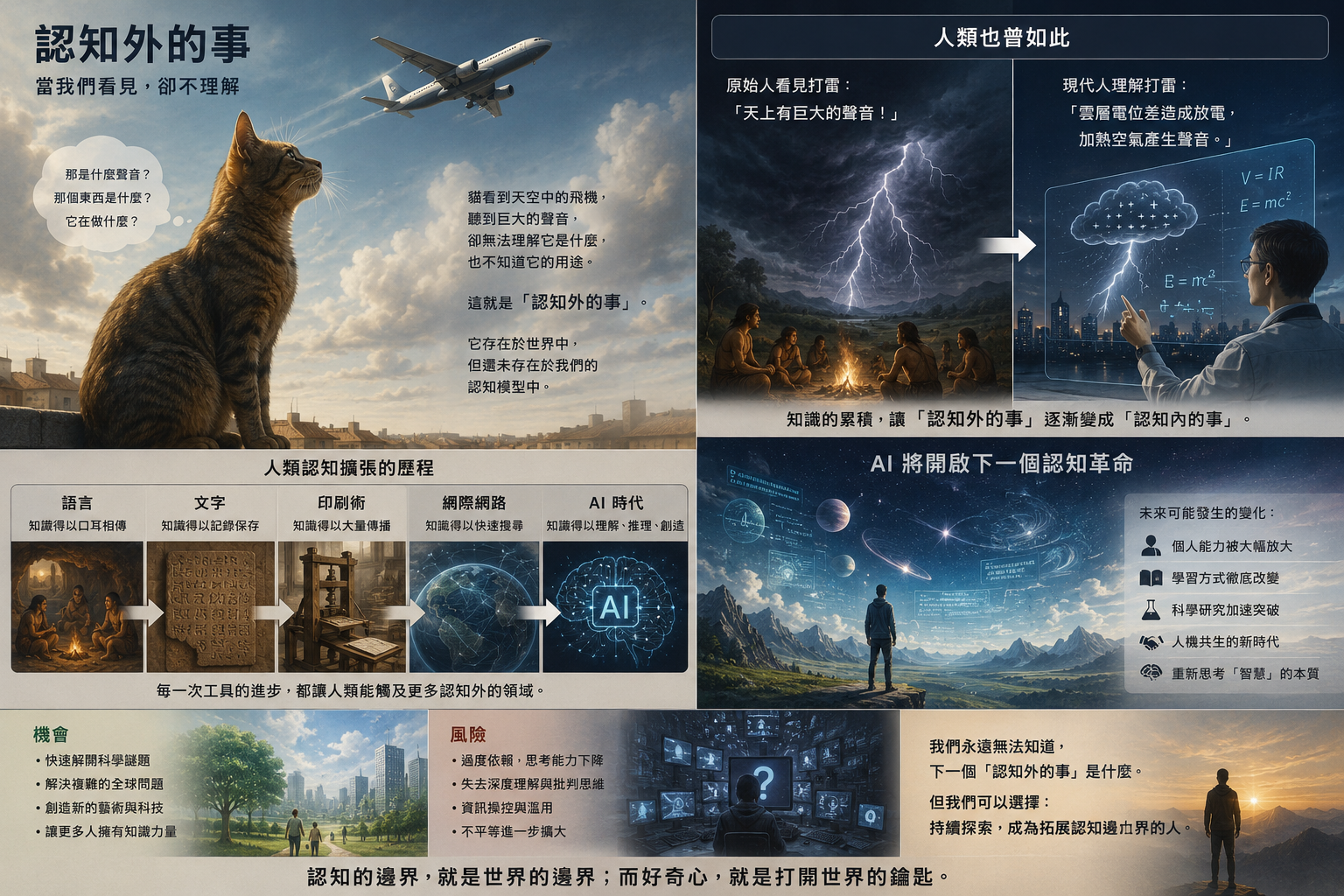
有一天,我看到一隻貓聽見天空傳來巨大的聲音。牠抬起頭,看見一個正在移動的物體。我知道那是一架飛機,但貓不知道。對牠而言,那是一個存在於世界之中、卻超出自身理解能力的事物。
貓可以知道有東西在天空移動,也可能知道那個東西會發出聲音,但牠無法理解飛機是什麼、為何能飛行、裡面載著什麼,以及它與人類文明的關係。
這讓我想到,人類其實也經常面對相同的處境。
知道,不等於理解
例如我們知道打雷是什麼。現代人知道雷聲來自大氣放電,知道閃電造成空氣瞬間膨脹而形成衝擊波。然而,如果繼續追問:電子為何帶電?自然常數為何如此?宇宙為何存在?我們很快又來到認知的邊界。
因此,「知道某件事存在」與「真正理解它」其實是兩個不同層次。
什麼是「認知外的事」
我將這種超出現有理解能力的事物稱為「認知外的事」。
認知外的事並非不存在,而是尚未被納入我們的大腦模型之中。當我們第一次接觸這類事物時,往往會產生一種特殊感受:既知道它存在,又無法完全理解它。
科學史其實就是人類不斷將「認知外」轉化為「認知內」的過程。
原始人看見閃電與雷聲,無法理解其機制。現代人理解電學與大氣物理。然而在今天,我們又面對新的未知:意識如何產生?暗物質是什麼?阿茲海默症真正的起始機制為何?
每個時代都有自己的認知邊界。
AI 與認知的擴張
AI 的出現,可能正在改變人類擴展認知的速度。
過去,人類發明了語言、文字、印刷術、電腦與網際網路。這些工具主要幫助人類保存與傳播知識。而 AI 的特殊之處在於,它開始協助人類操作知識、整合知識,甚至提出新的連結與假說。
因此,AI 不只是外部記憶體,更像是一種外部思考工具。
例如一位神經科學研究者,過去可能需要花費數個月閱讀大量文獻,才能建立對某個主題的整體理解。今天,AI 可以快速整理數百篇甚至數千篇文獻,協助研究者找出共同機制、研究缺口與潛在方向。人類於是可以把更多時間投入在提出問題、設計實驗與驗證結果。
從這個角度看,AI 正在幫助人類獲得某種「認知外能力」。一個人可以完成過去需要團隊才能完成的工作;一位科學家可以同時涉足程式設計、資料分析、圖像生成與知識管理;不同領域之間的界線開始被打破。
這並不是因為人腦本身突然變得更強,而是因為人類開始擁有新的認知延伸工具。
未來十年、一百年後,人類可能會生活在另一個今天難以想像的世界。正如原始人無法想像量子力學與人工智慧,今天的我們也未必能理解未來人類將擁有何種認知能力。或許未來的人類看待我們,就像我們看待不理解雷電的原始人一樣。
機會與風險
然而,AI 帶來的不只是機會。
如果人類過度依賴 AI,也可能失去部分獨立思考能力。正如 GPS 普及後,人們的導航能力下降;搜尋引擎普及後,人們不再記憶大量資訊。
因此,真正重要的不是讓 AI 替代思考,而是利用 AI 擴展思考。
回到那隻貓
回到最初那隻看著天空的貓。牠抬頭望向飛機,知道有某種東西存在,卻無法理解那是什麼。
也許今天的人類,在面對意識、宇宙與智慧本質時,也處於類似的位置。
而科學、哲學與人工智慧最有趣的地方,正是在於我們不斷接近那些認知之外的事物,並逐步將它們轉化為新的理解。
認知的邊界永遠存在,但人類最珍貴的能力,也許正是不斷跨越邊界的能力。
One day I watched a cat hear a huge sound coming from the sky. It lifted its head and saw something moving up there. I knew it was an airplane — but the cat did not. To the cat, it was something that existed in the world yet lay beyond its own ability to understand.
The cat could know that something was moving across the sky, and perhaps that the thing made a sound. But it could not grasp what an airplane is, why it can fly, what it carries inside, or how it relates to human civilization.
This made me realize that we humans often find ourselves in exactly the same position.
Knowing Is Not Understanding
Take thunder, for example. We moderns know that thunder comes from electrical discharge in the atmosphere, and that lightning makes the air expand instantly into a shock wave. Yet keep asking — why does an electron carry charge? Why are the constants of nature what they are? Why does the universe exist at all? — and we quickly arrive again at the edge of our cognition.
So "knowing that something exists" and "truly understanding it" are really two different levels.
What Are "Things Beyond Cognition"?
I call this kind of thing — something that exceeds our present ability to understand — a thing beyond cognition.
Things beyond cognition are not nonexistent; they simply have not yet been folded into the model our brain holds of the world. The first time we meet such a thing, we often feel something peculiar: we know it is there, and yet we cannot fully understand it.
The history of science is, in fact, the story of humanity continually turning the "beyond cognition" into the "within cognition."
Early humans saw lightning and heard thunder but could not understand the mechanism. We moderns understand electricity and atmospheric physics. And yet today we face new unknowns: How does consciousness arise? What is dark matter? What truly initiates Alzheimer's disease?
Every age has its own edge of cognition.
AI and the Expansion of Cognition
The arrival of AI may be changing the speed at which humanity expands its cognition.
In the past, humans invented language, writing, the printing press, computers and the internet. These tools mainly helped us preserve and spread knowledge. What is special about AI is that it begins to help us operate on knowledge, integrate it, and even propose new connections and hypotheses.
AI, then, is not merely external memory — it is more like an external thinking tool.
A neuroscience researcher, for instance, might once have spent months reading a mountain of papers just to build an overall understanding of a topic. Today, AI can rapidly organize hundreds or even thousands of papers, helping the researcher find shared mechanisms, gaps and promising directions. Humans can then pour more time into asking questions, designing experiments and verifying results.
Seen this way, AI is helping humans acquire a kind of "beyond-cognition ability." A single person can do work that once required a team; one scientist can reach across programming, data analysis, image generation and knowledge management at once; the lines between fields begin to dissolve.
This is not because the human brain has suddenly grown stronger, but because humans have begun to possess new tools that extend cognition.
Ten years, a hundred years from now, humanity may live in a world we can scarcely imagine today. Just as early humans could not imagine quantum mechanics or artificial intelligence, we today may not be able to understand what cognitive abilities future humans will hold. Perhaps future humans will look upon us the way we look upon early humans who could not understand thunder and lightning.
Opportunity and Risk
And yet AI brings more than opportunity.
If we lean on AI too heavily, we may also lose some of our capacity for independent thought — just as people's sense of navigation declined after GPS became common, and people stopped memorizing large amounts of information once search engines were everywhere.
What truly matters, then, is not letting AI replace thinking, but using AI to expand thinking.
Back to the Cat
Return to that cat gazing at the sky. It looks up at the airplane, knows that something is there, yet cannot understand what it is.
Perhaps we humans today, facing consciousness, the cosmos and the nature of intelligence, stand in a similar place.
And the most fascinating thing about science, philosophy and artificial intelligence is precisely this: that we keep drawing nearer to the things beyond our cognition, and step by step turn them into new understanding.
The edge of cognition will always exist — but humanity's most precious ability may be exactly this: the ability to keep crossing it.